
Archive for ‘Marketing Tips’

January 1st, 2013

11 Best Blog Posts from Dave Kerpen, Jay Baer, Erik Qualman and Others

4.1.1

I don’t know about you, but for me, the challenge with the internet isn’t that there isn’t good content — it’s that there’s so much good content.

People like Dave Kerpen, Jay Baer, Erik Qualman, Michael Stelzner and others are constantly sharing helpful tips and techniques that can help you grow your business. Because there’s so much good content out there, I spend part of my day just sorting through what I want (and need) to read.

With that in mind, I’ve selected 11 best marketing blog posts to help you kick things off for the new year. Each post has an insight or a tip that can help you make 2013 your best year ever, so take a spin through them. And feel free to leave a comment below with your favorite blog post so you can add to this list of the best marketing blog posts.

Here goes:

  1. Top 10 Unlikeable Companies of 2012 by Dave Kerpen. Dave and I are good friends and meet just about every week with Erik Qualman, Andrea Vahl, Chuck Martin and others on our Five Star Speakers initiative. This is one of my favorite posts this year, especially since GoDaddy is on the list.
  2. 26 Truths About Me and Convince and Convert by Jay Baer. This 5,000 word post was so good I printed it out and read it in bed while watching the New Year’s Eve celebrations. This is an amazingly transparent post with tons of great information about Jay and his team at Convince & Convert.
  3. Socialnomics Video 2013 from Erik Qualman. Erik is another good friend and a key player on the Five Star Speakers team. He’s best known as the author of Socialnomics and Digital Leader, which are both excellent books. If you haven’t seen his updated version of the Socialnomics video, check it out — Erik has an amazing ability to take simple statistics and turn them into interesting insights.
  4. How to Build a Platform and Get Noticed in a Noisy World by Michael Stelzner. This is actually a video interview conducted with Michael Hyatt. Michael Stelzner is the founder of Social Media Examiner (always worth reading) and Michael Hyatt is one of my absolutely favorite bloggers and authors. Get to known them both by checking out this post.
  5. Google Plus Emerging as a Back Door to Top Search Results by David Meerman Scott. I got to know David as he mentored me through the launch of Go Mobile and came away impressed with his desire to help others. Most of David’s posts are insights and perspectives on where digital communications is and where it’s headed, but this post is more of a “How To,” which is what makes it especially useful for members of the 60 Second Marketer community.
  6. The 10-Step Content Marketing Checklist by Sonia Simone and Brian Clark. Damn, I wish I was half as smart and eloquent as Sonia and Brian. And I’m not just saying that. Copyblogger continues to impress with great content that’s extremely well-crafted and articulated. The post mentioned here is just one of many great examples on their site. Check it out.
  7. SEO: 10 Secrets You Can Use to Get Google to Rank Your Website Higher by Lon Safko. There’s an interesting story behind this post. Lon, who is part of the Five Star Speakers team, sent us all an email with tips on SEO. I suggested that his email was so all-encompassing that it should be turned into a blog post. Now, a version of it is on Lon’s website (as well as ours!).
  8. 10 Ways to Grow Your Facebook Following by Andrea Vahl. When I have a question about Facebook, who do I turn to? Either Andrea Vahl or Phyllis Khare, both of whom know more about Facebook than anyone else I know. Check out Andrea’s post to kick start your Facebook initiative.
  9. Walking Before Running into Augmented Reality by Chuck Martin. Chuck is one of the smartest guys I know. This post from him offers some excellent insights into the world of augmented reality. Put on your thinking cap and check out this post. When it comes to mobile, Chuck is the guy.
  10. The Social Customer by Adam Metz. This isn’t a blog post as much as it’s a book by my friend Adam Metz. If you want to learn how your business can use social CRM to acquire, monetize and retain fans, friends and followers, check out this book. It’s packed with useful tips and techniques.
  11. Re-Branding, Re-Designing and Re-Inventing: 3 Signs it’s Time by Phyllis Khare. I’ll make one prediction for 2013 that I know will come true — some company in Southern California is going to hire Phyllis Khare to run their marketing and social media and will grow by leaps and bounds as a result. Phyllis is one of the authors on Facebook All-in-One Marketing for Dummies and knows this stuff inside out. This is a great post by Phyllis with some good tips on re-inventing yourself.

I hope you find these posts helpful. I know I have. And let me know about any other posts you think are worth reading in the comments section below.

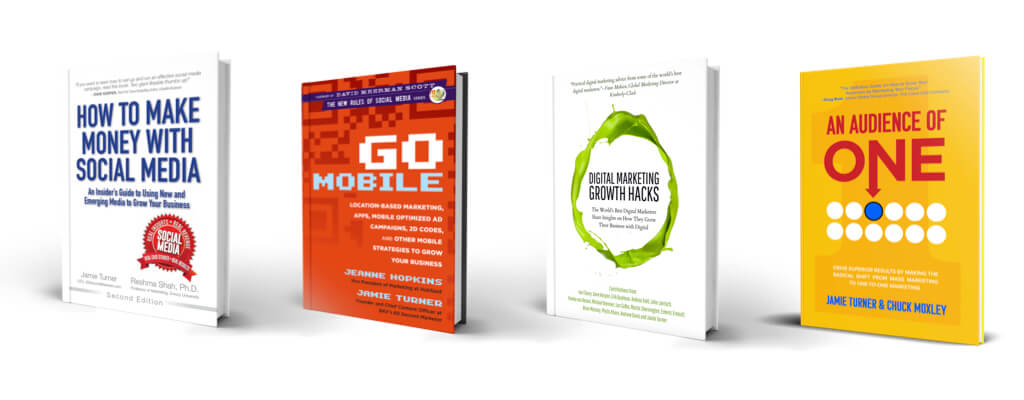
Jamie Turner is the Founder of the 60 Second Marketer and co-author of “How to Make Money with Social Media” and “Go Mobile.He is also a popular marketing speaker at events, trade shows and corporations around the globe.

Comment.001

Print Friendly
January 23rd, 2012

What is Mobile Marketing?

If you’re like a lot of people, you might be asking, “What is mobile marketing?” It sounds like a basic question, but in doing some keyword research for the 60 Second Marketer, I found that “What is mobile marketing?” is the third most common mobile search phrase after “mobile marketing” and “mobile media.”

So, given that, I thought I’d shed some light on what mobile marketing is and how it’s used.

The definition of mobile marketing is pretty straightforward — it’s the set of techniques and practices that enable organizations to connect and engage with their audience in an interactive manner through any mobile device.

The tools and techniques that are used in mobile marketing included the following:

  • Mobile websites
  • Mobile apps
  • Mobile paid search
  • Mobile display (banner) ads
  • Location-based advertising
  • Location-based services (e.g., Foursquare, SCVNGR, WHERE, etc.)
  • Near Field Communication and BlueTooth (i.e., wireless communication between two devices)
  • SMS and MMS (i.e., text messaging)
  • 2D codes (i.e., QR codes, EZ codes, Microsoft TAG, etc.)
  • Mobile email

In Go Mobile (affiliate link), the book I’ve written with Jeanne Hopkins from HubSpot, we provide a roadmap on how to set-up, launch and manage a mobile marketing campaign.

What follows is an excerpt from the introduction in the book. It’s currently the #1 mobile marketing book in America, so if you like what you see, feel free to take a closer look by clicking here.

Here’s the excerpt:

“Are you curious about how to use mobile marketing to grow your business? Would you like to know how to use QR codes, mobile apps, location-based marketing and other mobile tools to increase your sales and revenue? And are you wondering how companies like Coca-Cola, Delta and Starbucks use mobile marketing to connect with their customers?

If so, we have some good news. That’s exactly what we’ve set out to do in Go Mobile. We’ve demystified mobile marketing and re-packaged it as a simple, easy-to-understand tool that you can use to grow your sales and revenue. The questions you have about how to set-up, launch and run a mobile marketing campaign have been answered in this book.

There are four primary mobile operating systems in the U.S. Percentages indicate total U.S. market share.

It’s worth noting that mobile marketing isn’t just an evolutionary new technology, it’s a revolutionary new technology. In fact, it’s a once in a generation shift in the way consumers connect with brands. And it’s going to have more impact than radio, TV and the personal computer – combined.

How can we say that? How can something as small as a smartphone be as powerful as radio, TV and the personal computer combined?

The reason is because mobile provides all three of those things (and more) in a small device that can be put in your pocket. There’s no need to be tied down by a big box that needs to be plugged in all the time. Instead, you (and your customer) can access it whenever they want and wherever they are.

In fact, research by Morgan Stanley indicated that 91% of all mobile phone users have their phones within arm’s reach 24/7. Additional research by Nielsen shows that the growth of the iPhone was 10 times faster than the growth of America Online.

It gets even more incredible. According to the 60 Second Marketer, there are 6.8 billion people on the planet, 4.0 billion of whom own a mobile phone. Do you know how many own a toothbrush? 3.5 billion. That’s right, more people own a mobile phone than own a toothbrush.

What’s more, Gartner predicts that by 2013 the primary way people will access the internet is via their mobile browsers. In other words, more than half the time someone accesses the internet, they’ll be doing it from a mobile phone. That has huge implications for how your business needs to connect with prospects and customers.

Given all that, it’s not surprising that you’re curious about mobile marketing and that you’re reading this book. After all, people like you have realized that mobile is going to be huge. No, wait. Strike that. Mobile is huge. And it’s going to get even huger. (Is huger a word? Why, yes. Just Google it from your mobile device if you don’t believe us.)

Is Mobile Marketing Right for You?

The starting point for anyone interested in diving into mobile marketing isn’t to run out and develop an app or set up a mobile website. Instead, the starting point is to begin by asking yourself, “is mobile marketing right for my business?”   

With that in mind, we’ve come up with a handy little checklist designed to help you figure out if mobile is right for you.

Mobile marketing is right for your business if…

  • You need new customers
  • You want existing customers come back more frequently
  • You want to improve your profit margins
  • You need to appeal to a broader audience
  • You want to differentiate your brand
  • You’d like to improve your marketing ROI
  • You want customers to spend more money each time they buy from you
  • You’re looking for new distribution channels
  • You want to grow your market share
  • You want to be in front of your customers 24/7

See where we’re going with this? The odds are pretty good that one or more of the items listed above is important to you. Who doesn’t want more customers? Who doesn’t want to improve their marketing ROI? And who doesn’t want to differentiate their brand?

5 More Reasons Mobile Marketing Might be Right for Your Business

If the list of reasons above wasn’t enough to get you started in mobile marketing, here are five more that will almost certainly help you along your way.

  1. It’s easier than you think. Setting-up, launching and running a mobile marketing campaign is easier than you may think. If you’re interested in getting a helping hand, reach out to an SMS service provider, your digital advertising agency or a mobile ad network like AdMob, iAd or Millenial Media. A quick phone call to any one of those entities will help you understand just how easy it is to get started in mobile marketing. (Of course, reading this book will help, too.)
  2. There’s a huge untapped mobile audience. The mobile audience is huge, which leaves a large gap between the amount of marketers targeting mobile users, and the actual amount of people using mobile devices, like smartphones. This means that now is the ideal time to test out a mobile marketing campaign for your business to see how effectively it can build your brand and sell your products.
  3. Mobile converts prospects to customers. The conversion rate for many mobile marketing campaigns is dramatically higher than the conversion rate for traditional campaigns. eMarketer reports that 1 in 10 people currently redeem mobile coupons, which is 10 times higher than the redemption rate of some traditional coupons channels.1
  4. It costs less than traditional methods. The cost of running a mobile marketing campaign is currently less than the cost of running many traditional marketing campaigns. Because of that, the ROI of most mobile campaigns is higher than other marketing channels. What’s wrong with a healthy ROI? Nothing.
  5. People respond to mobile. Just like it’s easy to start a campaign on your end, it’s also easy for customers to opt-in or respond to an ad through a click of a button on their smartphone. Easy sells; and more people are willing to reply to a text message or a mobile banner ad than are willing to clip a coupon out of a newspaper.

The bottom line is that there are amazing opportunities for any business interested in taking a dive into mobile marketing. Better still, mobile marketing is not that hard. If you have a basic understanding of marketing, it’ll be a piece of cake. And even if you don’t have a basic understanding of marketing, it’s incredibly easy to learn.”

If you’d like some quick tips on how to get started in mobile marketing, check out the video below from the 60 Second Marketer YouTube Channel. It includes some additional tips on how to get started in mobile marketing quickly and easily.

Posted by Jamie Turner, Founder of the 60 Second Marketer and co-author of “How to Make Money with Social Media” and “Go Mobile.He is also a popular marketing speaker at events, trade shows and corporations around the globe.

Print Friendly
November 15th, 2011

How Complex is a Marketer’s Job Today? This Chart Has the Answer.

In 1965, you could reach 85% of the TV viewing audience by running just 3 TV spots. Today, in order to reach 85% of the viewing audience, you’d have to run over 125 commercials. This statistic alone is proof that a modern-day marketer’s job is much more complex than it used to be.

The chart below, shared with me by the kind folks at ExactTarget, drives home the same point. In the early 1990s, marketers had a handful of tools that they had to manage. Today, the number of tools a marketer needs to manage has grown by more than 500%.

Given the complexity of running a marketing campaign these days, I wouldn’t be surprised if the three martini lunch started making a comeback.

Posted by Jamie Turner, Founder of the 60 Second Marketer and co-author of “How to Make Money with Social Media” and “Go Mobile.” He is also a popular marketing speaker at events, trade shows and corporations around the globe.

Print Friendly
August 16th, 2011

How to Ask Your CEO for a Bigger Marketing Budget

If you are like most managers, when it comes down to it, you are downright scared of being direct and to the point and telling your CEO in no uncertain terms, “I want more money for marketing!”

Think about it.  There’s a conspiracy that encourages people to bury their most important wants and desires. Many management consultants advise using probing and consultative questions to draw people out.  They say to avoid being direct and straight-forward.  People hem and haw and they are even afraid to ask you what they want to ask you the most. They feel vulnerable about being honest and up-front. It petrifies even the best of us!

Yet when it comes to being successful in business, being frank, open and clearly asking people to give you what you want is what wins the day.  

John Baker, a veteran Fortune 25 management and leadership consultant and author of the new book The Asking Formula – Ask For What You Want And Get It, says the world would be a better place if marketers were totally up front and said “I’m selling windows today; are you buying?”

Is asking for a bigger marketing budget at the top of your to do list? If so, here are some tips on how you can ask your CEO for a bigger budget.

Baker spent several years studying the fears and trepidation people demonstrate in situations across the whole spectrum of human interactions. He concluded that people do not know the best way to get what they want. He then documented the simplest tactics and strategies that he observed in the people who were getting exactly what they were after.  His discovery was absolutely earthshattering in simplicity.

Very simply, the most successful people ask for what they want. Then they give the three very best reasons that explain why it makes perfect sense to say yes.

Here’s an example.

A company intrapreneur has worked for months with the target top executive, created a devastatingly beautiful project plan, addressed scheduling and pricing issues, developed an integration plan, customization plans, a communications strategy, etc.   After all of the time, effort and energy he knows that he has overcome the financial, technological and even the human issues with flying colors.  What he doesn’t know is if the executive will commit the marketing money needed to set it all in motion.

Even the most experienced, young and old are often stumped over asking someone for a clean and final decision. They stumble and bumble their way through touchy feely talk about their hobbies, the weather, their pets, family or weekend plans, anything but what they are really after.

Oh sure, all sorts of experts tell you that it’s important to build a relationship, or you have to draw out the prospect, or listen for buying clues, and any number of other items, but the crucial, bottom line issue is that they never get around to asking the big question.

Yet the quickest and best way to ask for the answer you need is to go right up to his client and say:

“Will you please approve the marketing budget now? I‘ve answered all your questions. You’ve seen the correlations between multiple repeat tests and predicted results.  You’ve expressed support for the all the ideas and everyone is standing by.  You’ve seen how everything works, how well integrated it will be, that it’s going to make a real difference. How about it?”

“It is crucial,” Bakers says, “to identify the exact most important request, and brainstorm before you decide on the best reasons. Each reason needs to be carefully selected from a larger number of options and be backed by three important facts.”

It’s about that easy, and the power of this strategy is more than a little amazing. Baker has shown that this method can be successfully used to penetrate difficult accounts, close difficult sales calls, shorten a sales cycle, protect price margins, reduce meeting time, speed up Powerpoint presentations, structure personnel reviews, sales letters, company communications with suppliers, corporate memos and even email messages.

What’s more it is proven to be quite helpful in corporate and business personal interactions with personnel, especially with supervisors and staff.

And it really helps if you put your money here your mouth is:

“Let’s implement the plan as follows. You approve the budget today. I’ll meet with your top three Directors by the end of the week. We’ll finalize the deployment, assign responsibility for the action items, identify the start date and set the implementation schedule, and document the action planning on the company-wide calendar. Then we’ll kick things off and monitor the progress and the results each day. And it will happen in less than a week!”

“Conversations are clearer and there is less misunderstanding and I earn lots of points for being thoughtful”, he says.

Baker’s formula has three key rules:

  1. Only offer information that is meaningful.  The rest is trivial.
  2. Get to the point and ask for what it is you want.
  3. Be quick about it.

Building a relationship is great, but taking responsibility and delivering the results is what builds trust. The biggest problem with never getting a direct answer, is that it gets in the way of the real progress. It’s pointless. It wastes time and effort. It allows for procrastination. It enables people to avoid rejection. After all, if you are busy probing the needs of the prospect you don’t have to risk actually doing the work.

Can you image a vendor at a ballpark consultatively selling you a hot dog:  “On a 1 – 10 scale rate your level of discomfort with your hunger?”  “Tell me your main objective with the hot dog?” “When you had a hot dog before, how satisfied were you with the mustard and ketchup ratio?”

Isn’t he more effective when he just yells:

“Hot dogs, hot dogs, come and get your hot dogs!”

Just give me the damn hot dog!


John Baker has held top leadership positions in sales, client service and operations in Fortune 25 companies for more than 25 years.  John is a graduate of the University of Minnesota with BA and MBA degrees. He is a member of the National Speakers Association, a noted speaker on topics of leadership, leader development, and building winning organizations. John lives in Minnesota with his family. His new book The Asking Formula – Ask For What You Want And Get It is scheduled for late fall 2011 release. For more information visit www.theaskingformula.com

Print Friendly
July 14th, 2011

Top 10 Marketing Tips to Use LinkedIn to Your Advantage

LinkedIn is a great social networking tool for businesses, recruiters, marketers and professionals wishing to connect and establish relationships. Many users sign up to be a part of the professional community but are unclear as to how to establish connections and use this tool to their advantage.

AccountingDegree.com filled us in on some top tips to amp up your LinkedIn profile. I’ve broken down the top 10 that will help you get connected, establish meaningful relationships and use this tool to your full advantage.

1. Brand yourself: You don’t want to get lost in the mix, so it’s important to make your presence known. How? For starters, always make sure you have an updated professional photo to help create a personal connection with others. Personalize your URL link, it’s a great way to make yourself more marketable versus keeping the random URL given to you by LinkedIn. Include a summary so those connecting with you can learn more about you and your experiences. Think of this as your mini commercial selling yourself to businesses and marketers.

2. Increase your Visibility: LinkedIn ranks high in terms of page ranks in Google. Best way to get your profile more visibility is to make your information public by selecting “Full View” in settings. This increases your chances of coming up in search engines and gives you a greater possibility to connect with more professionals and companies.

3.  Promote yourself: LinkedIn allows you to publicize your profile so use this to your advantage. You can also create a LinkedIn signature to include when you comment on blogs or other social platforms. It’s a great way to get your profile out there across multiple social mediums.

4. Groups: Start a group or get involved in a group, either way this is an area you want to be involved in. When you start a group you become the “connector” and center of the conversation. It’s a great way to let people know your strengths and create a community of people with similar interests that can ultimately help you expand your personal database.

5. Applications: There are lots of great LinkedIn applications out there, however for all you bloggers, WordPress blog RSS is the cream of the crop. This app gives you the ability to syndicate your blog through your profile so those connected with you can view your blog and be updated with new posts and information.

6. Events: Connect with your fellow LinkedInners beyond the social networking page. From conferences to happy hours there is always something going on in the business world and you should be a part of it. Check out events in your area and view the RSVP list so you know who will be in attendance. Message your connections and let them know you will be there too.

7. Be a Resource: Listen to your connections questions and show that you can be of service to them. Show them what can you and your company bring to the table. Introduce your connections with others and become the “connector” and a person of resource. It’s a great way to grow your influence on LinkedIn.

8. Use Keywords: It’s the same concept when you are publishing blogs or websites, you want your link to appear as an answer to whatever keyword was entered into the search engine. Pick some keywords that you want to be associated with when searched. Use these words in your public profile to increase awareness about your brand or company and improve your search ranking.

9. Repurpose Content: So, what does this mean? Post content and mentions about you or your company on LinkedIn to spread the word and brag a little big about your accomplishments. Company Buzz is a great tool that sifts through Twitter to find whose talking about your company and what’s being said. Highlight these mentions on your profile and add to the buzz.

10. Customer Company Profile: This customizable page option helps company’s enhance their recruiting tactics and provide a targeted experience for potential connections. Through this tool a company can provide prospective employees with updated career information as well as participate in recruiting efforts.

Posted by Rebecca Wilson, Marketing Analyst for the 60 Second Marketer.

Print Friendly

The 60 Second Marketer is an online community that provided tools, tips and tutorials for marketers around the globe. It was founded by Jamie Turner, co-author of "How to Make Money with Social Media" and "Go Mobile." For more information about the 60 Second Marketer and Jamie Turner, visit the "contact" link at the top of this page.

© 60 Second Marketer